Author name: nasimsayed320@gmail.com

Digital Reputation Score In 2026
Uncategorized

The Digital Reputation Score In 2026: The Verdict AI Makes About Your Business Before Anyone Clicks

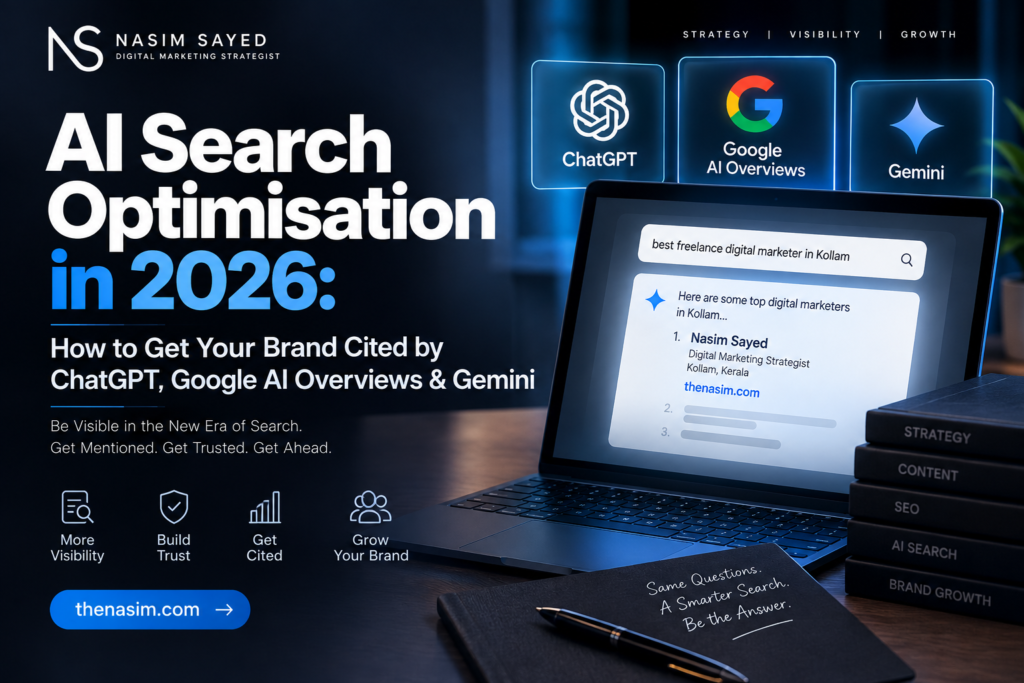
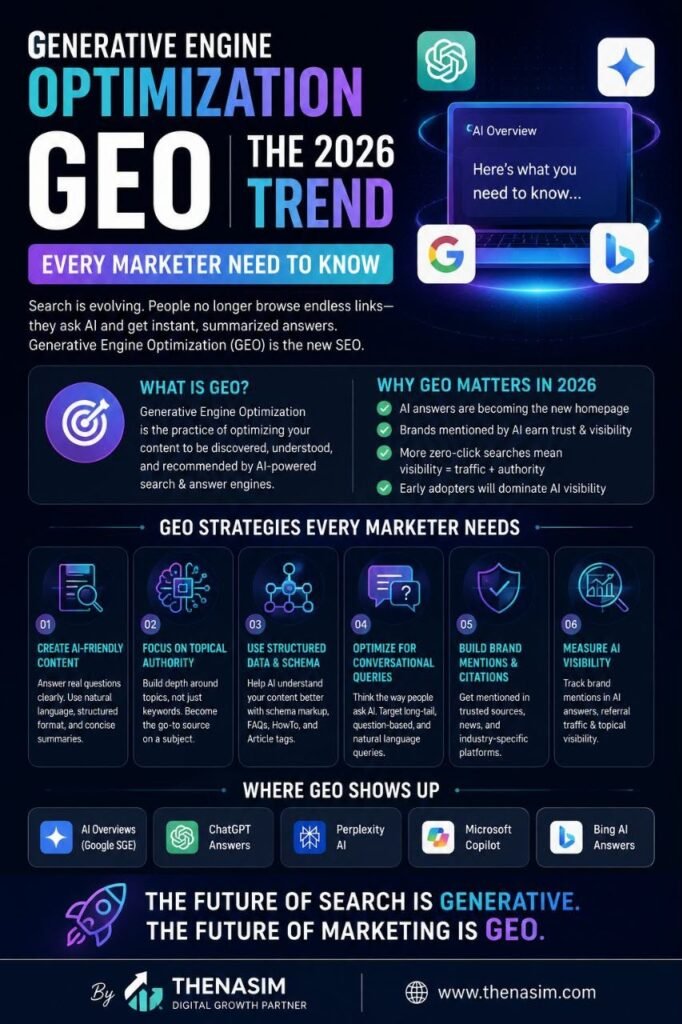
Digital Reputation Score In 2026 Before a single person visits your website, something else has already formed an opinion about your business: AI. Tools like ChatGPT, Google’s AI Overview, Gemini, and Perplexity are already answering questions about your business in real time. “What does this business do?” “Is it trustworthy?” “Who are its competitors?” They often do this without ever visiting your homepage. Instead, their responses are pieced together from directory listings, customer reviews, outdated bios, news mentions, social profiles, and other information scattered across the web. This is where Digital Reputation Score In 2026 becomes a critical business metric. It represents the invisible verdict AI forms about your company before a potential customer ever clicks on your website. If your Digital Reputation Score In 2026 is based on inconsistent, outdated, or incomplete information, AI may present an inaccurate picture of your business—costing you visibility, trust, and potential customers. As AI-powered search continues to grow, improving your Digital Reputation Score In 2026 is becoming just as important as traditional SEO. A Real Example: When AI Got the Story Wrong Imagine a local digital marketing agency searching for its brand in Google’s AI Overview, expecting to see its SEO expertise, performance marketing services, and recent client success stories highlighted. Instead, the AI generated a summary based on an outdated directory listing, a stale “About” page, and a handful of third-party reviews. The AI confidently described the agency as primarily a web design company—even though SEO, performance marketing, and AI-driven digital strategies had been its core services for years. Its latest certifications, successful campaigns, and client achievements were missing simply because they weren’t consistently published across the online sources AI relied on. This perfectly illustrates why Digital Reputation Score In 2026 matters. AI doesn’t understand your business the way you do—it understands the digital footprint your business leaves across the web. Your Digital Reputation Score In 2026 is shaped by how consistently your services, expertise, achievements, and brand messaging appear across trusted websites, directories, reviews, and industry mentions. If those signals are outdated or inconsistent, AI can confidently present an inaccurate version of your business to potential customers before they ever visit your website. Improving your Digital Reputation Score In 2026 ensures AI tells the right story about your brand, increasing trust, visibility, and customer confidence. Why This Happens: AI Reads Signals, Not Intentions AI models don’t call you to ask what your business actually does. They synthesize an answer from whatever publicly available content they can find and treat repetition as truth. If your homepage says “marketing agency ” but your LinkedIn still says “web design company,” and your Google Business Profile lists you under “advertising service,” AI has three conflicting signals. And it will pick one sometimes the wrong one. That mismatch is exactly what hurts businesses the most in AI search visibility today. It’s rarely one error. It’s usually a dozen unsynced details across the web. How to Audit Your AI Visibility Strategy Before you can fix your Digital Reputation Score, you need to see it. Here’s the process: 1. Ask AI About Your Business Run these questions through ChatGPT, Google’s AI Overview, Gemini, and Perplexity: • What does [Business Name] do? • Who are the [service] companies in [city]? • Is [Business Name] good for [service]? • What are the strengths of [Business Name]? • Who are competitors of [Business Name]? 2. Score the Results Create three columns and sort what you find: Category What It Means Correct AI accurately describes your business. Missing AI leaves out services, wins, or credentials. Incorrect AI states something outdated or false. 3. Compare It to Reality Ask yourself: • Does my homepage clearly explain what I do? • Are my services obvious? • Are my contact details and business information current? • Do my LinkedIn profile, Google Business Profile, and website tell the story? Fixing Your Digital Reputation Score: A Practical Framework Once you know where the gaps are, here’s the order of operations that actually moves the needle. Step 1: Update Your Website First Your website is still the anchor source AI leans on most. • Rewrite your homepage and “About” page to clearly state what you do. • Add pages for each core service. • Publish case studies with results. • Include author bios, contact details, and business information to build credibility. Step 2: Make Your Brand Information Consistent Everywhere This is the step that pays off fastest. Align your business name, description, services, and contact details across: • Google Business Profile • LinkedIn • Social media • Business directories • Review platforms When every source repeats the story, AI stops guessing and starts trusting. Step 3: Earn Authoritative Mentions AI weighs third-party validation. Build it through: • Guest articles • Features in industry publications • Podcast or interview appearances • Backlinks from trusted relevant websites Step 4: Add Structured Data Schema.org markup. Organization, LocalBusiness, Person, Service, Article. Gives search engines and AI models a machine-readable map of who you are and what you offer. It removes ambiguity that AI would otherwise fill in with guesswork. Step 5: Publish Fresh, Expert Content • Write in-depth articles answering the questions your customers actually ask. • Update older content regularly so AI keeps finding accurate information instead of relying on what it indexed years ago. Step 6: Monitor and Recheck Improving your AI visibility strategy isn’t a one-time fix. Recheck AI answers every week and track whether the inaccuracies fade and new content starts surfacing in AI-generated summaries. What Actually Moves Fast.. What Doesn’t Not every fix pays off at the same speed. Based on real-world results, consistency across your brand’s profiles tends to produce the fastest visible shift. Often within weeks. Because it removes the conflicting signals AI was struggling to reconcile. Earning mentions and backlinks, on the other hand, takes longer. It depends on publications, timing, and relationship-building, so it’s a slower but more durable improvement to your AI visibility strategy. The Mistake That Hurts Businesses The single

The Digital Reputation Score
Uncategorized

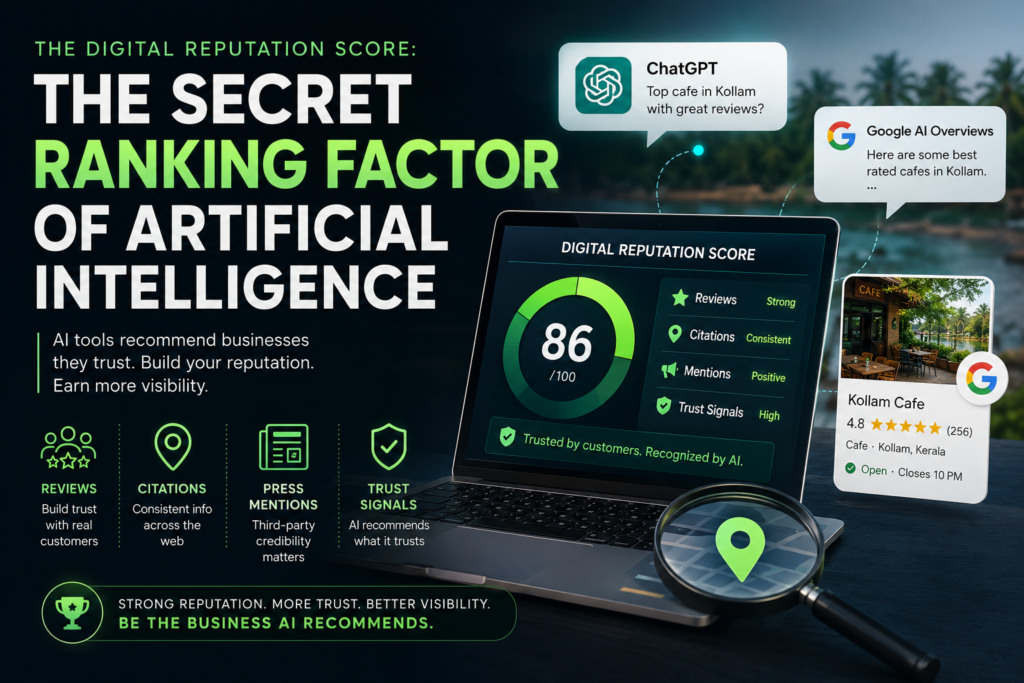
The Digital Reputation Score: The Secret Ranking Factor of Artificial Intelligence 2026

If you have noticed that Artificial Intelligence tools like ChatGPT or Google’s Artificial Intelligence Overviews are confidently recommending some businesses while completely ignoring others with similar rankings, you are not imagining things. There is a pattern behind it. It comes down to something called the Digital Reputation Score. Think of your Digital Reputation Score as your business’s reputation. Built by what customers and trusted websites say about your business, the Digital Reputation Score is. It is not a metric you can check on a dashboard. It is a combination of signals that Artificial Intelligence systems piece together to decide whether your business is trustworthy enough to mention. That is what the Digital Reputation Score is all about. As a marketer working with small businesses and entrepreneurs across Kerala, I have watched this play out again and again. Businesses that understand the Digital Reputation Score are quietly pulling ahead in Artificial Intelligence visibility, even when their traditional search engine optimization looks average, because they know how it works. What Is the Digital Reputation Score? The Digital Reputation Score is the collective trust signal your business sends across the internet. Reviews, citations, press mentions, and consistency of information. Artificial Intelligence systems are used to decide whether you are credible enough to be recommended, and that’s the key to understanding the Digital Reputation Score. Unlike a keyword ranking, the Digital Reputation Score is not something you optimize with a single page tweak. It is built cumulatively across your Google Business Profile, review platforms, local directories, and any site that mentions your business by name, and all of these things contribute to your Digital Reputation Score. Why Artificial Intelligence Systems Care About Your Digital Reputation Traditional search engines rank pages. Artificial Intelligence systems, on the other hand, are trying to answer a question directly. Which means they need to feel confident recommending a specific business, not just linking to it, and the Digital Reputation Score plays a big role in this. From what I have observed working with clients, a few clear patterns show up: Businesses with consistent reviews get mentioned more confidently in Artificial Intelligence-generated local recommendations, and that is because of their good Digital Reputation Score. Brands that are frequently cited by websites with consistent business information across the web are easier for Artificial Intelligence systems to reference, and that helps their Digital Reputation Score. Companies with Google Business Profiles, press mentions, and industry recognition show up more often in Artificial Intelligence Overviews and Artificial Intelligence assistant answers, and all of these things are part of the Digital Reputation Score. Businesses with online footprints or inconsistent information get skipped, even when their traditional search engine optimization rankings are decent, because their Digital Reputation Score is not good. In short, Artificial Intelligence systems reward businesses that look trustworthy from every angle, not the ones that rank well on page one, and the Digital Reputation Score is what helps them make that decision. What Improving Your Digital Reputation Score Actually Looks Like I will be upfront: I have not yet had a client where I could conclusively measure an isolated change in Artificial Intelligence-generated answers. Artificial Intelligence search is still. It is genuinely hard to attribute a shift to any single factor, including the Digital Reputation Score. Anyone who claims otherwise now is probably overselling it, and I do not want to do that with the Digital Reputation Score. What I have done is help businesses strengthen the underlying signals that Artificial Intelligence systems appear to rely on, and that is what improving the Digital Reputation Score is about. That work typically includes: Improving and fully completing their Google Business Profile, which is an important part of the Digital Reputation Score. Encouraging recent customer reviews, which helps to build trust and improve the Digital Reputation Score. Fixing business citations across directories, which is also important for the Digital Reputation Score. Earning mentions from industry websites, which can help to improve the Digital Reputation Score. Adding data to their website, which can also help with the Digital Reputation Score. After making these changes, clients consistently saw local search visibility, more branded searches, and a more consistent presence across the web, and I believe that is because their Digital Reputation Score improved. Common Mistakes That Quietly Hurt Your Digital Reputation Score Most local businesses are not ignoring their reputation on purpose. They simply do not realize these small gaps are adding up. The three I see often: 1. Ignoring customer reviews. Many businesses never ask customers for reviews or do not respond to the ones they already have. A steady stream of genuine recent reviews builds trust with both people and search systems. That helps to improve the Digital Reputation Score. 2. Inconsistent business information. Different phone numbers, addresses, business hours, or business names across Google, social media, and directories create confusion. That inconsistency quietly weakens credibility with Artificial Intelligence systems trying to verify who you are, and that can hurt your Digital Reputation Score. 3. Treating the website like a brochure. A site that never gets updated with content, customer success stories, FAQs, or fresh photos signals that the business is not active. Outdated websites look less trustworthy both to visitors and to the systems evaluating them. That can also hurt your Digital Reputation Score. How to Improve Your Artificial Intelligence Visibility Strategy: A Starting Point You do not need a six-month overhaul to start improving your Digital Reputation Score. Here is where I would tell any Kerala business owner to begin: Complete and update your Google Business Profile. It is the direct trust signal Artificial Intelligence systems reference for local businesses, and it is an important part of the Digital Reputation Score. Collect 5 customer reviews this week. Fresh, authentic reviews signal trust and activity, and that helps to improve the Digital Reputation Score. Audit your business info across directories. This fixes inconsistencies that confuse Artificial Intelligence systems and searchers alike. That can help to improve the Digital Reputation Score. Pursue press or

Scroll to Top